
Cotton Comes to Harlem
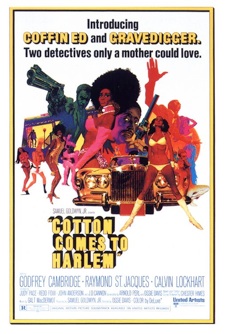
COTTON COMES TO HARLEM was a groundbreaking movie when it debuted in 1970, just before the Blaxploitation wave began to swell. It was only the second mainstream feature directed by a black man (the first was Gordon Parks’ THE LEARNING TREE a year earlier in 1969), and director Ossie Davis also co-wrote the script and wrote the lyrics to several of the songs by Hair composer Galt McDermot. The film doesn’t wear well, unfortunately – it seems padded now with car chases and over the top stunts that involve guys flying way high into the air, again and again. The story is as confusing as most Film Noirs, and that’s what this is, in an early “urban” format. Himes developed several novels around black New York police detectives Gravedigger Jones and Coffin Ed Johnston, here played respectively by slick Godfrey Cambridge and a very dour Raymond St. Jacques. They’re the real story, particularly how they interact with the black community as cops of color. There’s a scene where ridiculously costumed black militants taunt them for being Uncle Toms. Cambridge just decks the revolutionary and that sums up how these two roll – fists are flying, guns are always at the ready, and lots of people get shot. Cambridge and St. Jacques are an interesting duo in that they seem to share absolutely nothing in common, and don’t even interact on the usual cop/buddy level of their interracial successors, Danny Glover and Mel Gibson in the LETHAL WEAPON films, and Eddie Murphy and Nick Nolte in 48 HRS. (Walter Hill, 1982). The most watchable scenes in the movie involve Calvin Lockhart as a charismatic black preacher/hustler who is running some kind of back to Africa financial scam. Lockhart is so charismatic that you can easily understand how black women in particular would fall, even clamor for anything he offered that involved his beautiful face. But he runs afoul of not only Cambridge and St. Jacques but also the mob, so we have an unusual scene of the black cops telling the Italian mafia to make way for new black criminal entrepreneurship. Davis was aware enough to have a character or two make a speech about representing the new black experience, but otherwise COTTON COMES TO HARLEM works very hard to meet the requirements of the white police/action drama. Only in some of the dialogue passages are there direct and oblique winks and nods to the African-American audience that flocked to this film – it was a major boxoffice hit and helped pave the way for the explosion of Blaxploitation that followed, beginning with SHAFT (Gordon Parks, 1971) and SUPERFLY (Gordon Parks, Jr., 1972). This film doesn’t have the power and flair of those later efforts, probably because Davis’s skill is not primarily film directing – he is far outshone as a director by the more visually oriented Parks father and son, although he was smart to hire one of the best cinematographers in the business at the time, Gerald Hirschfeld. He also has a singular cast of black character actors, from Redd Foxx and Teddy Wilson to a great turn by Cleavon Little as a strung out junkie, that he knows how to direct from an actor’s perspective. Only the white characters seem strident and unsubtle, which is to be expected given the era and the nascent genre. COTTON COMES TO HARLEM doesn’t pack the punch that classic Blaxploitation does in putting it to Whitey, but it deserves respect and admiration, and Godfrey Cambridge has to be one of the coolest dudes to ever wear a porkpie hat.
Dir.: Ossie Davis, 1970. 97 mins. Formosa Prods./MGM. Produced by Samuel Goldwyn Jr. Screenplay by Arnold Perl, Davis, based on novel by Chester Himes. Cinematography by Gerald Hirschfeld. Edited by Robert Q. Lovett. Art direction by Emanuel Gerard. Music by Galt MacDermot. With Godfrey Cambridge, Raymond St. Jacques, Calvin Lockhart, Judy Pace, Redd Foxx, Emily Yancy, John Anderson, Lou Jacobi, Eugene Roche, J.D. Cannon, Mabel Robinson, Cleavon Little, Dick Sabol, Teddy Wilson, Maxwell Glanville.
Wednesday, September 29, 2010

New Class in October

Skywalking:
The Life and Films
of George Lucas
Filled with revelations about the origins and making of American Graffiti, Star Wars, The Empire Strikes Back, Raiders of the Lost Ark, Read More
Dale Pollock will be offering a new class at Reynolda House this fall as part of the Portals of Discovery program. “Morality Tales in Film: Kieslowski’s DECALOGUE” will take place on five Tuesday evenings from 6-9 p.m. beginning Oct. 19, 2010 and ending Nov. 16, 2010 in Reynolda House’s auditorium. Each week Dale will discuss two episodes of this groundbreaking Polish TV series about the Ten Commandments. To register go to www.reynoldahouse.org.



Contact and Follow







I watch at least one movie every day and write about it. These are not reviews, but mini-essays on aspects of the film that I find interesting. Look for a new film discussed each and every day!


Dale M. Pollock is an award-winning teacher, writer and filmmaker. He is based in Winston-Salem, NC where he is a Professor of Cinema Studies and Producing at the University of North Carolina School of the Arts. Read more


DALE’S RATING: 3 popcorns
Photo by Diana Greene



