
Marathon Man
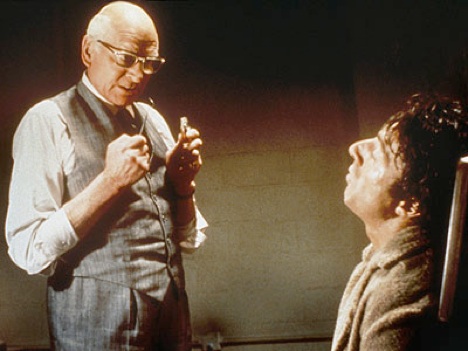
Movie a Day Blog hadn’t seen MARATHON MAN since its original release 25 years ago, and the movie holds up well. It’s the only outright thriller John Schlesinger directed in an eclectic and currently undervalued career. This is the filmmaker behind DARLING (1965) and A MIDNIGHT COWBOY (1969), among other distinguished films, and he brings a sensitivity to character that other directors of his generation often overlooked. This is one of Laurence Olivier’s most remembered Hollywood roles – no one who originally saw the film can forget his probing dental work on Dustin Hoffman, not in one but two scenes that were reportedly trimmed back after preview audience members became physically ill in the theater. MARATHON MAN is a crackerjack of a film, beginning with propulsive driving chase sequence with a fiery ending, and never letting up on the adrenaline rush for the lengthy two-hour-plus running time. Schlesinger is stylistically very much a late 1960s filmmaker: there are discordant shots, editing and music that accompany Roy Scheider’s entrance, for example. Schlesinger and screenwriter William Goldman, working from Goldman’s best-seller, are not afraid to confound audience expectations by having Hoffman’s brother (come again?) and Nazi hunter Scheider die unexpectedly and early in the film, thus jarring the audience in the same way the cinematography (by the great Conrad Hall) and the editing do. Poor Dustin Hoffman is still stuck playing a college student (at least he’s a grad student this time around) nine years after THE GRADUATE (Mike Nichols, 1967), and on some level he seems slightly miscast in this role. Al Pacino was also considered, and might have displayed his paranoia in a more raw New York form, rather than Hoffman’s Jewish neuroticism. Schlesinger doesn’t turn away from the plot’s realistic bloodletting, which is frequent and prodigious as the hunt for Olivier gets underway in earnest. Playing a variation on the German medical experimenter Dr. Josef Mengele, Olivier is shaved-head evil incarnate, although with a touch of culture (we meet him listening to German lieder in a rainy South American hideout). He’s a spectral figure, and his constant refrain, “Is it safe?” ended high up on the American Film Institute list of most famous movie sayings. The least successful part of the film is the love affair between Hoffman and Marthe Keller, who was cast only after Julie Christie turned down the role. Schlesinger proves to be a master of suspenseful pacing, especially in a scene when Hoffman discovers someone after him in his apartment, methodically prying apart the door that shields him. And the very conscious delay between the two dental torture scenes (and that’s exactly what they are, make no mistake) works effectively to maximize suspense, especially when the electric drill makes an appearance and all of our teeth suddenly start hurting. The scene is almost all played off of Olivier’s benign face and the bright dental light. Hoffman, who trained exhaustively to be believable as a marathon runner, then has to live up to the film’s title and run for his life. Paralleling the opening outstanding chase scene, an even more dramatic one concludes the film. The finale, an imaginatively staged confrontation between Hoffman and Olivier, ends in an unexpected way with a great pay-off on a weapon introduced in an earlier dramatic killing. MARATHON MAN doesn’t end up making any great points about the nature of evil, other than it endures and shows up in unexpected places. Even in the dentist’s office.
Dir.: John Schlesinger, 1976. 125 min. Paramount Pictures. Produced by Robert Evans, Sidney Beckerman. Screenplay by William Goldman, based on his novel. Cinematography by Conrad Hall. Edited by Jim Clark. Production design by Richard MacDonald. Music by Michael Small. With Dustin Hoffman, Laurence Olivier, Roy Scheider, Marthe Keller, William Devane, Fritz Weaver, Richard Bright, Marc Lawrence, Allen Joseph, Tito Goya, Ben Dova, Lou Gilbert. Viewed on DVD.
Sunday, July 17, 2011

New Class in April 2011

Skywalking:
The Life and Films
of George Lucas
Filled with revelations about the origins and making of American Graffiti, Star Wars, The Empire Strikes Back, Raiders of the Lost Ark, Read More
Dale Pollock will be offering a new class at Reynolda House this spring as part of the Portals of Discovery program. “From High Noon to Noir: American Cinema of the ‘50s” will take place on six Tuesday evenings from 6-9 p.m. beginning April 5, 2011 and ending May 17, 2011 in Reynolda House’s auditorium. Each week Dale will introduce a 1950s cinema classic and lead a discussion following the film. To register go to www.reynoldahouse.org.



Contact and Follow







I watch at least one movie every day and write about it. These are not reviews, but mini-essays on aspects of the film that I find interesting. Look for a new film discussed each and every day!


Dale M. Pollock is an award-winning teacher, writer and filmmaker. He is based in Winston-Salem, NC where he is a Professor of Cinema Studies and Producing at the University of North Carolina School of the Arts. Read more


DALE’S RATING: 4 popcorns
Photo by Diana Greene




